Posts

Showing posts with the label Welsh History

Lady Llanover and the National Costume of Wales

Image
Augusta Hall, ‘Lady Llanover’, 1802-1896 To start off Women’s History Month which falls on St David’s Day, I thought Lady Llanover who was a pioneer for Welsh folk culture and keeping Welsh traditions alive was quite apt. Augusta Waddington was born on the 21st of March 1802 to Benjamin Waddington and Georgina Port, Llanover, Monmouthshire.  Augusta married Benjamin Hall of Abercarn and Hensol - he was an MP before becoming a peer in 1859. He oversaw the building of the great clock of Westminster, the bell and tower was called 'Big Ben' in recognition of his work.  Lady Llanover was an advocate for Welsh folk culture, her home became a meeting place for Welsh poets, authors and musicians. She favoured the traditional ways of life, which included Welsh speakers as servants, Welsh services at Llanover church, and made sure the Welsh language was taught at the two schools in Llanover.  Augusta became one of the main promoters of the triple harp as the national instrument o...

Who is Sybil Margaret Thomas?

Image
  Most notably, Sybil Thomas was known for her role in women's rights pre-World War One. Her daughter Margaret Haig Thomas was a prominent figure during the suffrage movement and went on to become the secretary of the Newport (south Wales) branch of the Women's Social and Political Union (WSPU)  Image depicting Sybil and her husband David found here  (c. 1910-1915)      You can find a portrait of Sybil here  which is located in the Amgueddfa Cymru collections. The portrait was done by Solomon Joseph Solomon, who was a British painter and a founding member of the New English Art Club. Solomon also painted a portrait of Sybil's husband, David Thomas. (David Thomas' portrait can be found here ) David Thomas had an interest in pursuing a political career and became a Liberal MP for Merthyr until 1910. He inherited Cambrian Collieries in Clydach Vale which belonged to his family. In 1916, David was ennobled as Baron Rhondda, and in 1918 became Viscount Rhon...

Let's Discuss... Welsh traditions and symbols.

Image
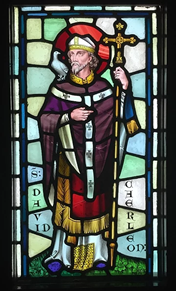
 Let's Discuss... Welsh traditions and symbols. As I am writing this, it is currently the 1st of March which is also known as St David's Day in Wales. So, to any Welsh readers, Dydd  Gŵyl Dewi Hapus! Origins of Saint David's Day:     Saint David was recognised as the national patron saint in the 12th century at the height of Welsh resistance to the Normans and was canonised by Pope Callixtus II. At the moment, St David's Day is not considered a national holiday, unlike Saint Patrick's Day, however, the 1st of March is a day of celebration. During my time in school, the 1st of March meant a 'day off' where we would take part in an Eisteddfod/Eisteddfodau (pronounced Ice - steth - vod / Ice - steth - vod - eye) celebrating Welsh culture including singing Welsh songs, dressing up in our national costume, and writing poems and stories about Welsh culture - such as the story of Beddgelert.      The picture below is a stained-glass depiction of Saint David, ...